Some hotels are simply places to sleep. Le Dupleix, tucked into the heart of Pondicherry's White Town on Rue de la Caserne, is not one of them. It is a stay that becomes part of the trip. We spent a full day here with my family, and by the time we left, all of us were quietly planning the next visit.
The building itself is the first storyteller. Le Dupleix is set in an 18th-century French colonial mansion that once served as the residence of the Mayor of Pondicherry. It is named after Joseph François Dupleix, the celebrated Governor General of French India in the 1740s. The property has been carefully restored as a 14-room heritage boutique hotel, keeping its colonial bones intact — high ceilings, teak floors, deep verandas, and an inner courtyard built around a centuries-old tree. Walking through the green, ivy-draped archway at the entrance feels like stepping softly out of modern India and into another century.
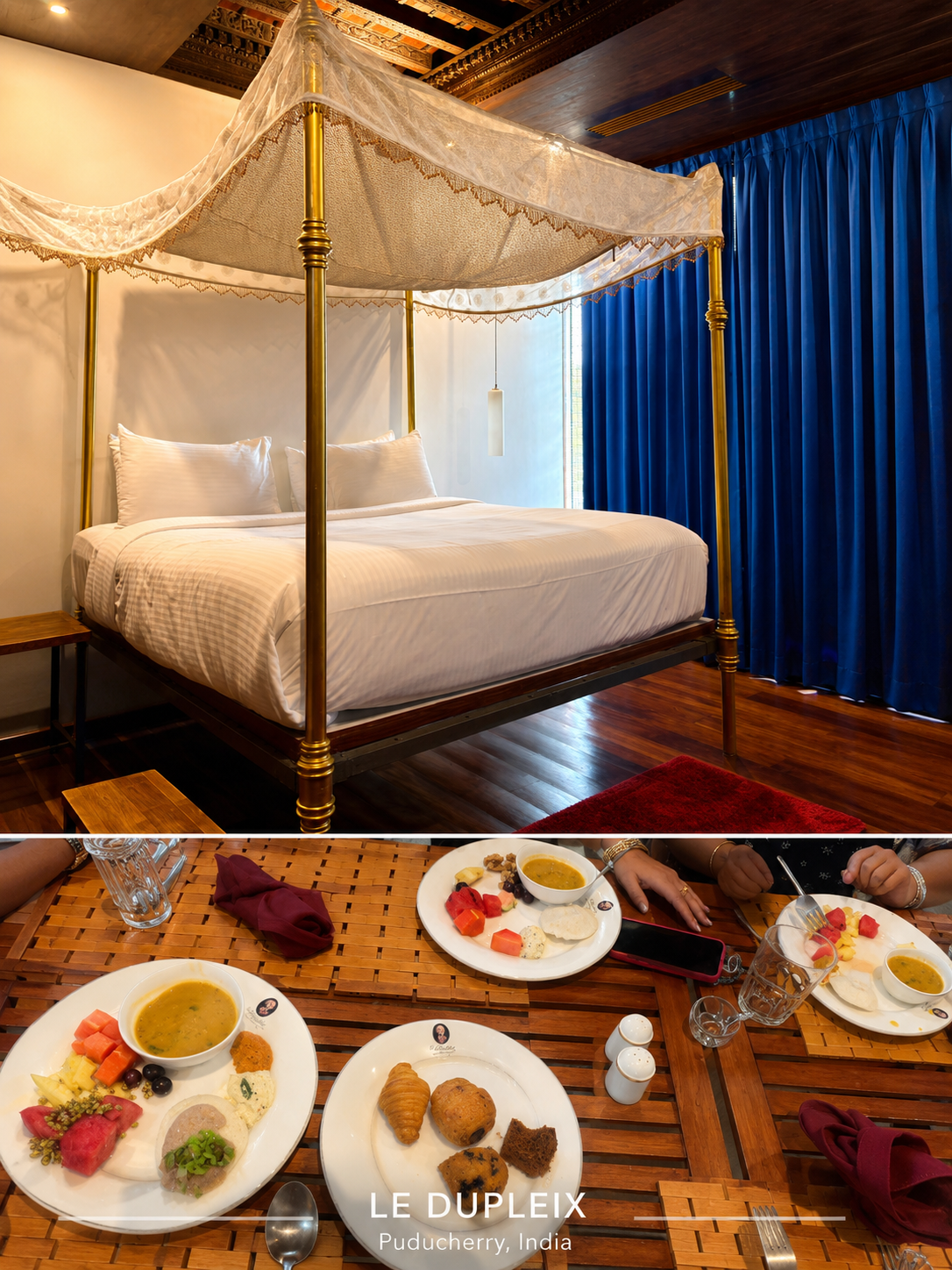
Our room set the tone for the rest of the day. A grand four-poster bed in polished brass, draped with a delicate ivory lace canopy, sat under an intricately carved wooden ceiling — every panel hand-detailed, the kind of craftsmanship you usually only see in museums. The deep blue velvet curtains, the warm teak floor, the soft red rug at the foot of the bed — every element was chosen with care. It was elegant without ever feeling stiff. My mother kept touching the carved beams and saying, very quietly, “Look at this work.”
The service was the next surprise. From the moment we arrived, the staff seemed to remember everything — our names, our preferences, the fact that my father liked his coffee strong and my sister did not eat onions. Nothing was rushed. Doors were opened, bags were carried, questions were answered with a small smile. When my mother asked about the history of the building, a young man at the reception sat down with us for ten minutes and walked us through it as if he were telling a family story. That is rare.
Breakfast, served in the courtyard restaurant, was the heart of the day. We sat at a woven wooden table beneath the old tree, with sunlight filtering through the leaves. The spread was generous and beautifully composed — fresh fruit, a warm South Indian section, a French corner of croissants and pastries, and a chef who came out to ask how we wanted our eggs. My plate had papaya, watermelon, grapes, a small idli with coconut chutney, a spoon of fragrant sambar, and a flaky almond croissant on the side. My sister built hers around the fruits and the soup. My parents stayed loyal to the South Indian counter. We ate slowly, talked even more slowly, and let the morning take its time.
Later in the day I sat in the room with a small plate I had carried up myself — kiwi, banana, papaya, dragon fruit, fresh paneer with chilli flakes, and slices of green guava with a sprinkle of salt and pepper. The simple homely touch of fruit on a porcelain plate, eaten in a room with a carved teak ceiling above me, somehow captured the entire spirit of Le Dupleix: thoughtful, unhurried, and quietly luxurious.
A few things we loved, in short:
• A genuine 18th-century mansion, not a recreation — the heritage is real and you can feel it.
• Only 14 rooms, so the place stays peaceful and personal.
• Hand-carved wooden ceilings and four-poster beds that make every room feel like a small museum suite.
• Warm, attentive staff who remember the small things.
• A breakfast spread that blends French and South Indian traditions beautifully.
• A central courtyard with an old tree — the best seat in the house for any meal.
• Walking distance to the Promenade, Sri Aurobindo Ashram, and the French Quarter cafés.
By evening, the light in the courtyard turned a soft gold, and the four of us sat for one last cup of filter coffee before heading out for a walk along the sea. Le Dupleix did not feel like a hotel we had visited. It felt like a beautiful old house that had, very kindly, made room for us for the day.

About the Author
Kirandeep Kaur
I explore technology, simplify complex ideas, and share what I learn along the way — mostly SAP, AI and enterprise tech, sometimes everything else.
More about Kirandeep →